
Calculating speed is one of the fundamental concepts in both physics and everyday life. Whether you’re driving a car, running a race, or simply trying to measure how fast something is moving, knowing how to calculate speed is essential.
The formula for calculating speed is simple yet incredibly useful in a wide variety of situations, from travel planning to scientific experiments.
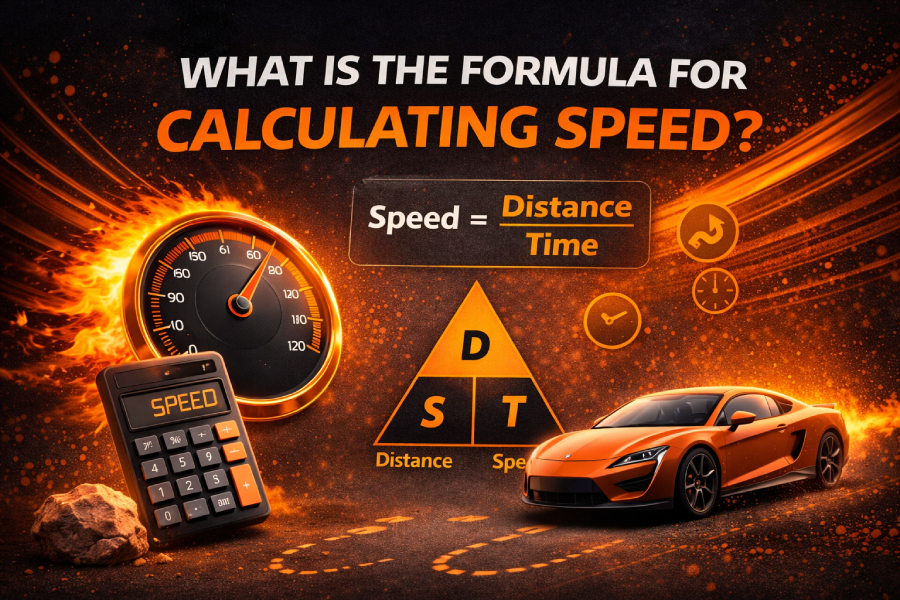
The formula to calculate speed is:
Speed = Distance ÷ Time
This formula tells you how quickly something is moving over a certain distance in a given amount of time. The units of speed depend on the units used for distance and time. For instance, if you measure distance in kilometers and time in hours, speed is measured in kilometers per hour (km/h). Similarly, if distance is in meters and time in seconds, speed will be in meters per second (m/s).
Understanding this formula is crucial for accurately calculating how fast things move in various real-world scenarios, such as vehicles, athletes, or even light. Keep reading for more information on this topic.
Understanding the Key Components: Distance and Time
Before diving into speed calculations, it’s important to understand the components that make up the formula. Speed is determined by dividing distance by time, so knowing how to measure these components accurately is key.
- Distance: This is the total path covered by an object, measured in units like meters (m), kilometers (km), or miles (mi).
- Time: This is the amount of time taken for the object to cover the distance, measured in seconds (s), minutes (min), or hours (h).
When you have both the distance and time, calculating speed is straightforward. For example, if you’re walking and know the total distance you’ve covered and how long it took, you can easily calculate your average speed. You can even use a free tool to convert steps to miles if you’re tracking walking distances.
How to Calculate Speed with Practical Examples
Let’s go over a few practical examples to see how the speed formula is applied in real-world situations. Understanding how to calculate speed is not just theoretical; it’s extremely useful when you’re planning travel or tracking performance.
Example 1: A Car Driving on the Highway
Imagine you’re driving a car that travels 240 kilometers in 4 hours. To calculate the speed, you divide the distance by the time:
Speed = 240 km ÷ 4 hours = 60 km/h
So, the car’s average speed is 60 kilometers per hour. This simple calculation can help you estimate how fast you’re driving on the highway.
Example 2: A Cyclist Pedaling Across Town
Let’s say a cyclist travels 40 kilometers in 2 hours. To find the speed, apply the same formula:
Speed = 40 km ÷ 2 hours = 20 km/h
Thus, the cyclist’s speed is 20 kilometers per hour. This can help you compare different modes of transportation.
These examples show how the speed formula can be easily applied to various activities. Whether you’re driving a car or cycling, knowing how to calculate speed helps you plan your journey and estimate travel time accurately.
To further understand how walking distances affect speed, you might find it helpful to explore how long does it take to walk 2 miles, which illustrates how distance and time are interconnected.
Rearranging the Formula to Solve for Distance and Time
While speed is often the primary focus, there are times when you need to calculate either distance or time instead. Fortunately, the speed formula can be rearranged to solve for either of these variables.
Solving for Distance
If you know the speed and the time, you can easily calculate the distance traveled. The formula for distance is:
Distance = Speed × Time
For example, if you are traveling at 80 km/h for 2 hours, the distance covered would be:
Distance = 80 km/h × 2 hours = 160 kilometers
This tells you how far you would travel at that speed in the given time.
Solving for Time
If you know the distance and the speed but need to calculate how long it will take, you can rearrange the speed formula to:
Time = Distance ÷ Speed
For example, if you need to travel 300 kilometers at a speed of 60 km/h, the time it will take is:
Time = 300 kilometers ÷ 60 km/h = 5 hours
This helps you plan how long your journey will take.
These rearranged formulas are useful when you need to figure out the time required to travel a certain distance or the distance you’ll cover in a specific amount of time. Resources like how to convert miles to feet can also help make these conversions easier.
The Importance of Units in Speed Calculations
When calculating speed, it’s crucial to use the correct units of measurement. The units you use for distance and time will determine the units for speed. Here are some of the most commonly used units:
Common Units of Speed
- Meters per second (m/s): Often used in scientific contexts or when measuring very fast-moving objects.
- Kilometers per hour (km/h): Commonly used for vehicles, particularly in countries that use the metric system.
- Miles per hour (mph): Common in the United States and the United Kingdom for road travel and vehicle speeds.
Converting Between Units
In many situations, you may need to convert between units. For example, converting kilometers per hour (km/h) to meters per second (m/s) involves multiplying by 1000 (for kilometers to meters) and dividing by 3600 (for hours to seconds). Understanding how to convert between units ensures you can accurately compare speeds in different contexts.
Instantaneous Speed vs. Average Speed
When you talk about speed, it’s important to differentiate between average speed and instantaneous speed.
- Average Speed: This is the total distance traveled divided by the total time taken, regardless of how the speed might vary during the journey.
- Instantaneous Speed: This is the speed at any given moment during the journey. It’s the reading shown on a car’s speedometer, for example.
Instantaneous speed is useful when you want to know your exact speed at a specific moment. Average speed, on the other hand, helps you understand the overall rate of movement over a given period.
Applications of Speed in Real Life
Speed calculations are not just academic; they have practical applications in many fields. From transportation to sports, speed plays a critical role in various industries and activities.
- Travel Planning: Speed calculations are essential for estimating how long it will take to get to a destination.
- Sports: Athletes track their speed to monitor performance and improve efficiency, whether in running, cycling, or swimming.
- Engineering: Engineers use speed calculations when designing vehicles, transportation systems, and machinery to ensure they meet performance requirements.
These applications show that speed is more than just a concept in physics; it impacts our daily activities and decisions, from planning travel routes to analyzing athletic performance.
Conclusion
In conclusion, understanding the formula for calculating speed is a valuable skill that you can use in many aspects of life. Whether you’re planning a trip, measuring an athlete’s performance, or even designing transportation systems, the speed formula is an essential tool. By mastering how to calculate speed and rearrange the formula to solve for distance or time, you gain a better understanding of motion and can make more informed decisions.